
UFC Live Betting Guide: How to Bet In-Play During a Fight
 Available in US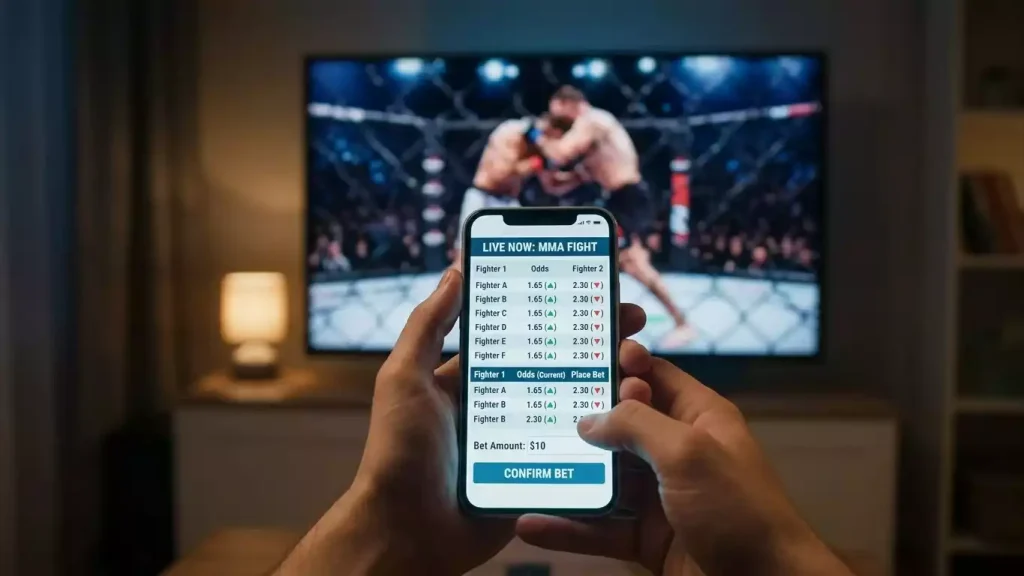
Contents
The UFC’s Fight-by-Fight Format Makes It Ideal for Live Wagering
I placed my first live UFC bet during a co-main event where the favourite got dropped in the opening thirty seconds. The moneyline on his opponent swung from 5/2 to 4/9 in real time, and I jumped on the favourite — who I still believed would win — at a price that had been unimaginable sixty seconds earlier. He recovered, dominated the next two rounds, and won by unanimous decision. That single bet paid more than my three pre-fight wagers combined.
UFC’s event format is almost tailor-made for in-play betting. The fight-by-fight structure and built-in rest periods between rounds create natural windows where odds recalibrate, and the gross gaming revenue from UFC betting has grown at a compound annual rate exceeding 18% over the past five years partly because live wagering drives enormous engagement. The UFC-TKO partnership group has said explicitly that the “fight-by-fight format naturally drives in-play wagering and live odds engagement” — they are building the product around it.
Which Markets Stay Open During a UFC Fight
Not every betting market remains available once the opening bell sounds. Understanding which markets stay live and which close is essential before you start wagering mid-fight.
The moneyline is the most consistently available live market. Most UK-licensed bookmakers keep the fight-winner market open between rounds and briefly during the round itself, though the window narrows as the action intensifies. If a fighter is hurt or in a dangerous position, the moneyline will either freeze or disappear until the situation stabilises.
Over/under rounds typically stays open between rounds, updating as each completed round changes the remaining possibilities. If you are watching a three-round fight and the first round ends without a finish, the over 1.5 line is already dead (it has hit), but the over/under 2.5 remains live with adjusted odds reflecting one completed round of data.
Method of victory is available live at some bookmakers but not all. The odds shift dramatically based on what is happening in the fight — if a fighter is dominating on the ground, the submission price shortens and the KO/TKO price lengthens. Round betting is occasionally available live but is the first market to close when a finish looks imminent.
Props like significant strikes over/under are generally not available live due to the difficulty of tracking real-time statistics accurately enough to set a line. These markets close before the fight starts and settle based on final stats.
Timing Your In-Play Bets: Between Rounds vs Mid-Round
The one-minute rest period between rounds is the premium window for live UFC betting. During this break, the odds fully recalibrate based on what happened in the previous round, and you have time to assess the situation without the chaos of live action distracting you.
Between-round betting rewards patience and observation. After round one, you know something the pre-fight market did not: how these two specific fighters interact. Maybe the favourite’s wrestling is neutralised by the underdog’s scrambling ability. Maybe a fighter who looked sluggish during fight-week media is actually sharp and fast in the cage. That sixty seconds of real competitive data is more valuable than hours of pre-fight film study, and the between-round odds reflect the market’s interpretation of that data.
Mid-round betting is faster, riskier, and requires a different skill set. The odds swing wildly based on what is happening second by second — a knockdown can shift the moneyline by 50 percentage points in an instant. I only bet mid-round when I see a specific situation that I believe the market is misinterpreting. The most common: a fighter gets dropped but recovers quickly and looks stable. The live odds overreact to the knockdown, pricing the dropped fighter as if they are badly hurt, when in reality they have cleared their head and are fighting normally. That overreaction creates a window to back them at an inflated price.
The technical limitation of mid-round betting is latency. What you see on your screen is slightly behind real time — broadcast delays of 5-15 seconds are standard. The bookmaker’s odds traders may be watching a faster feed. This means the odds you see during a dramatic moment may already be stale by the time you place your bet. Between-round betting eliminates this problem because both you and the bookmaker are working from the same information during the break.
Three Live Betting Scenarios and How to Approach Them
Scenario one: the favourite loses round one convincingly. The pre-fight favourite was priced at 1/3 and just got outstruck in the opening round. Their moneyline has drifted to even money or worse. This is the scenario I look for most often, because the market frequently overreacts to a single round. If I still believe in the favourite’s path to victory — perhaps their game plan typically takes a round to implement, or the opponent threw everything into round one and may fade — I take the favourite at a price that was unavailable before the fight started. The overall finish rate in UFC is around 53%, which means roughly half of all fights reach the later rounds where a superior fighter can adjust.
Scenario two: a grappler establishes control on the ground. The live method-of-victory odds shift heavily towards submission when a fighter secures a dominant position on the ground. But here is what the odds often miss: maintaining a dominant position and actually finishing a submission are very different skills. Many fighters who are excellent at holding top position rarely submit opponents at the UFC level. If I see a position-dominant grappler controlling an opponent without genuinely threatening submissions, I look at the “decision” line, which may have drifted out to an attractive price while the market focuses on the ground control.
Scenario three: a fight is clearly heading to a decision late in the bout. Midway through round three of a three-round fight, both fighters are on their feet, neither is hurt, and the pace has settled into a point-fighting rhythm. The “goes the distance” line should be short-priced at this point, but occasionally the market is slow to adjust, especially on lower-profile prelim bouts where fewer people are betting live. If I can get the “yes” on goes the distance at better than -300 with two minutes left in the final round and neither fighter showing any signs of finishing, I take it. The edge is small per bet but the hit rate is extremely high.
Live betting amplifies both the opportunity and the risk. The same discipline that applies to pre-fight wagering — staking plans, edge identification, emotional control — matters even more when the odds are moving in real time and the temptation to react impulsively is at its peak. I keep a separate bankroll allocation for live bets, capped at 20% of my total fight-night budget, and I recommend the same to anyone serious about incorporating in-play wagering into their overall UFC betting strategy.
