
UFC Betting Strategies: Value Hunting, Live Betting, and Data-Driven Approaches
 Available in US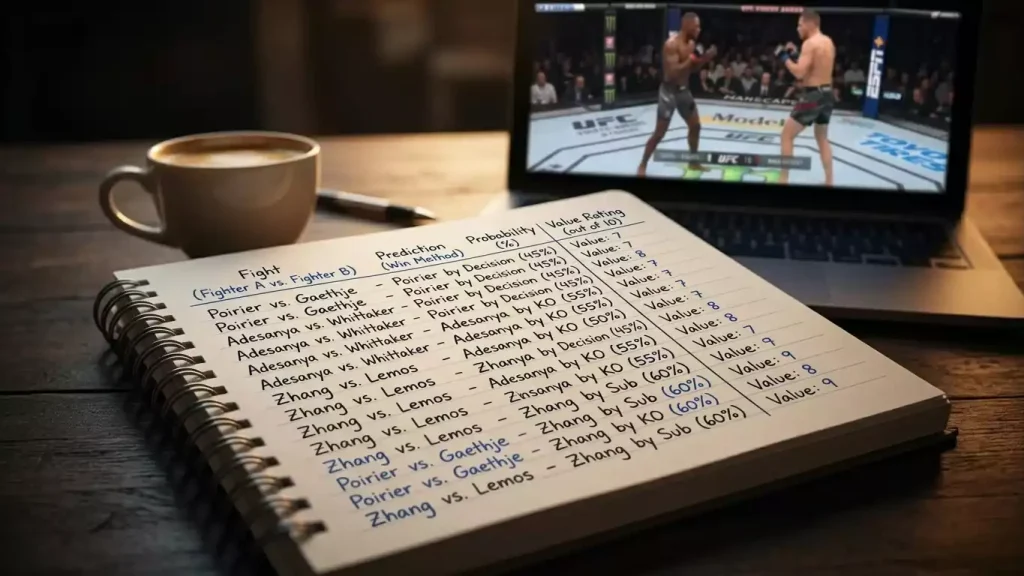
Contents
Process Over Prediction: What Separates Profitable UFC Bettors
Midway through 2021, I had my best prediction year ever — 61% win rate on moneyline picks across the entire UFC calendar. I was also barely profitable. The reason was embarrassingly simple: I was betting the same amount on a fight where I saw a 15% edge as on a fight where I saw a 2% edge. My picks were good. My process for acting on those picks was amateurish. That year forced me to confront a truth that separates recreational bettors from profitable ones — the prediction is only half the job. The framework you build around it determines whether good analysis translates into actual returns.
What I am laying out in this guide is not a collection of hot tips or a system you can follow blindly. It is a set of strategic approaches I use on every fight card, refined over nine years of betting MMA professionally. Value betting, live wagering, division-specific edges, and the discipline to walk away when the market offers nothing — each of these is a pillar of the process. None of them works in isolation, and none of them guarantees results on any individual fight. But applied consistently across the 43-plus events the UFC stages every year, they tilt the maths in your favour.
The idea that process beats prediction is not just my opinion — it is the consensus among sharps who have survived long enough to have a track record. What separates profitable UFC bettors from the masses comes down to frameworks for evaluating fights, strict bankroll discipline, exploiting market inefficiencies, and recognising when to stay on the sidelines. Strip away the flashy picks and what remains is boring, repeatable methodology. The punter who goes 58% on his selections but bets erratically will lose to the one who goes 54% but sizes and selects properly. I have watched it happen dozens of times, and it happened to me until I learned the lesson the expensive way.
Value Betting: Finding Odds That Underestimate a Fighter
Every bet you place is a statement about probability. When you back a fighter at 3/1 (decimal 4.00), the bookmaker is telling you they believe that fighter has roughly a 25% chance of winning. If your own analysis says 35%, you have found value — even though the fighter is more likely to lose than to win. That disconnect between your assessment and the market’s price is the entire game.
Value betting is not about picking winners. It is about identifying prices that are wrong. The distinction matters enormously, because it means you will regularly place bets that lose — and that is fine, as long as the cumulative edge across hundreds of bets is positive. The analogy I use with new bettors: imagine a coin that lands heads 55% of the time. You would not hesitate to bet on heads at even money, even knowing you will lose 45% of individual flips. The edge is invisible on any single bet but undeniable over a thousand.
In UFC specifically, value appears most often in three places. First, underdogs who have been overcorrected by public sentiment. The 2026 data is striking: fighters priced at +200 and longer won 39% of their bouts, up from a historical average of 28%. The market’s favourite-favourite bias creates a structural discount on dogs, and in a sport where one punch can end anything, that discount is frequently too steep.
Second, fighters returning from a loss. The market’s reaction to a loss is often disproportionate — a close split decision gets treated like a demolition, and the fighter’s price drifts beyond what the performance justified. If you re-watch the losing fight and conclude the fighter was competitive, the post-loss price may represent the best value you will ever get on them.
Third, stylistic mismatches that the market has not fully priced. A wrestler facing a striker with poor takedown defence sounds straightforward, but if the wrestler is coming off a striking loss and the market has soured on him, the price may not reflect the massive stylistic advantage he holds in this specific matchup. Context beats narrative every time.
Building your own probability estimate is the prerequisite. I do this by assessing five factors — style matchup, recent form, physical attributes, training camp intelligence, and historical performance against similar opponents — and assigning each a weight based on the specific fight. The output is a rough percentage that I compare to the implied probability of the odds. If the gap exceeds five percentage points, I consider it a bet. Below five, I pass. That threshold is arbitrary but has served me well as a filter against marginal plays that erode bankrolls over time.
A worked example helps here. Say you estimate a fighter has a 40% chance of winning and the bookmaker offers 11/4 (decimal 3.75). The implied probability of 3.75 is approximately 26.7%. Your edge is 40% minus 26.7% — a gap of over thirteen points. That is a strong value play, even though your fighter is more likely to lose than to win. Run that calculation before every bet. Write it down. If you cannot articulate the percentage gap in concrete terms, you are guessing, and guessing dressed up as intuition is still guessing.
Live Betting Strategies: Reading a Fight in Real Time
Round one ends. Fighter A controlled the grappling exchanges, landed a takedown in the final minute, and is visibly fresher. His price has shortened from 2.40 pre-fight to 1.80. Should you bet? That depends on whether the round told you something the pre-fight analysis missed — or simply confirmed what you already knew.
Live betting — wagering during the fight itself — is where UFC’s format gives bettors an edge that team sports rarely offer. The event-by-event structure drives massive in-play engagement, and the between-rounds breaks provide natural windows to reassess and act. But live betting is also where the most money is lost by people who confuse watching a fight with analysing it.
My live betting approach is narrow and disciplined. I identify two or three scenarios before the fight starts — specific conditions that would shift my probability estimate significantly. If Fighter B survives the first round without being taken down, I reassess because the primary threat has been neutralised. If Fighter A gets wobbled early, the market will overcorrect on his opponent, and I look for value on the fighter who was hurt if I believe in his recovery ability. These are pre-planned triggers, not impulsive reactions to the action.
Timing matters more than in any other market. Between rounds, the odds recalibrate based on the most recent action. If round one was a dominant wrestling display, the grappler’s live price will tighten — sometimes too much. The market overweights recency in live betting more than anywhere else. A fighter who lost round one narrowly is often priced as though he lost it decisively. That gap between perception and reality is exploitable, but only if you have the composure to bet against what you just watched with your own eyes.
One pattern I have exploited repeatedly: the body-shot fade. A fighter who lands heavy body shots in round one rarely gets credit in the live odds because the damage is invisible on camera. The commentators talk about the flashier head shots, the crowd reacts to the knockdowns that did not quite happen, and the bookmaker adjusts accordingly. But body work accumulates. By round two the opponent’s movement slows, their hands drop, and the fighter who invested in the body early starts landing upstairs. I have seen fighters drift from 1.50 to 1.90 on the live market after a round where they were actually doing the most damaging work. That kind of mispricing does not happen in pre-fight markets, and it is why I allocate a portion of my card budget specifically to live plays.
The gross gaming revenue from UFC has been growing at a compound rate above 18% for five years, and a significant chunk of that growth comes from live wagering. The bet365 partnership with UFC was explicitly framed around live action — the format “naturally drives in-play wagering and live odds engagement.” As bookmakers invest more in their live UFC products, the speed and accuracy of in-play pricing will improve. That means the easy inefficiencies of early live betting are closing, and the edge increasingly belongs to bettors who prepare specific scenarios in advance rather than reacting on instinct.
Division-Specific Edges: Exploiting Finish Rates and Pace
Not all weight classes bet the same. This sounds obvious, but I am constantly surprised by how many bettors apply the same analytical framework to a heavyweight headliner and a women’s flyweight opener. The physical dynamics, finish rates, and pacing patterns differ so dramatically between divisions that treating them identically is like using the same tactics for a sprint and a marathon.
Heavyweight is the most volatile division in the UFC. Nearly half of all bouts end by KO or TKO, and 70% of finishes come via strikes. The raw power at heavyweight means any clean shot can end a fight, which compresses the skill gap — a journeyman who lands one right hand can beat a ranked contender. For betting, this means under bets on total rounds and KO/TKO method of victory carry a structural edge, but moneyline favourites are less reliable than in other divisions because the variance is so high.
Bantamweight and flyweight are the polar opposite. These are the deepest, most technically refined divisions in the sport, where cardio advantages compound over three or five rounds and one-punch finishes are rare. The over on total rounds hits frequently, and decision outcomes are more common than in any other weight class. The women’s bantamweight division has sent 96% of its bouts past 1.5 rounds since 2020 — a trend so consistent it borders on automatic.
The middleweight and welterweight divisions sit in between — balanced enough that you cannot lean on a single structural tendency. Here, the style matchup dominates everything. A middleweight bout between two explosive strikers has a completely different profile from one between a wrestler and a counter-fighter. My approach in these divisions is to ignore base rates almost entirely and focus on the specific interaction between the two fighters’ skill sets.
Lightweight and featherweight tend to produce high-volume, fast-paced fights with a mix of finishes and decisions. The pace means cardio is a critical separator — fighters who fade in the third round at 155 or 145 pounds get finished or dominated on the scorecards. I track significant strikes landed per minute and striking differential (landed minus absorbed) more closely in these divisions than anywhere else, because volume and efficiency are the strongest predictors of outcomes when the athletes are evenly matched physically.
Building a Data-Driven Pre-Fight Framework
Every fight week, I fill out the same spreadsheet. It is not complicated — five columns, one row per fight. But it is the single most important tool in my process, because it forces me to commit to an assessment before I see the odds and prevents me from reverse-engineering a justification after I have already decided to bet.
Column one: style matchup advantage. Who controls where the fight takes place, and does their preferred range align with their opponent’s weakness? Column two: physical advantages. Reach, height, age, recent activity level. Column three: form trajectory. Are both fighters improving, declining, or stable? Column four: intangibles. Camp changes, corner quality, venue (some fighters perform very differently in certain locations or at altitude). Column five: my probability estimate, expressed as a percentage.
Only after filling out all five columns do I open the bookmaker’s odds page. If my probability estimate exceeds the implied probability by at least five points, the fight enters my potential bet list. If it does not, I mark it as a pass and move on. This sequence — analysis first, odds second — is non-negotiable. The moment you let the price influence your assessment, you stop being an analyst and become a punter looking for reasons to agree with a number someone else set.
The framework also forces me to confront my own uncertainty. When I cannot assign a probability above 55% to either fighter, the fight is genuinely close, and the correct play is usually to avoid the moneyline entirely and look at over/under or method of victory markets where the stylistic read carries more weight than the winner prediction. A fight I mark as 50-50 is not a fight I should be betting on the winner — it is a fight I should be exploring from a different angle or skipping altogether.
The data foundation matters too. I pull statistics from three free sources, cross-reference them for consistency, and flag any numbers that seem out of line. Discrepancies usually mean one source is counting differently — total strikes versus significant strikes, for instance — and catching those inconsistencies early prevents bad analysis downstream.
A word of caution on over-relying on numbers: small sample sizes plague UFC statistical analysis. Fighters compete two to four times annually, meaning even veterans may have only fifteen to twenty UFC fights generating statistics. A fighter’s takedown defence rate based on twelve fights and forty-seven attempts is not the same kind of data as a batsman’s average across two hundred innings. I treat UFC stats as directional indicators, not gospel. They tell me where to look, not what to conclude. The stylistic tape review fills the gaps that the spreadsheet cannot, and I never skip it — even when the numbers seem to tell the whole story.
I cover the analytical process in more detail in the line movement guide, where understanding the data feeds into reading market shifts.
Knowing When to Pass on a Fight
The most profitable bet I place on most cards is the one I do not place. That is not a motivational poster quote — it is an accounting reality. Every marginal bet I skip is capital preserved for a fight where the edge is genuine.
A typical UFC event has twelve to fourteen fights. On an average card, my framework identifies three to five fights where I have a probability edge above the five-point threshold. The other eight or nine fights are passes. Some are too close to call. Some involve fighters I do not have enough data on — debuting fighters or regional transfers whose previous opponents I cannot properly evaluate. Some have prices that are perfectly efficient — the bookmaker has nailed the probability, and there is no margin left for me.
Passing is psychologically difficult because every fight feels like a missed opportunity. Social media amplifies this — your timeline fills with other bettors celebrating wins on fights you sat out, and the temptation to expand your criteria creeps in. Resist it. The fighters who lose you money are not the ones you picked wrong; they are the ones you should never have bet on. Discipline is not about willpower on any individual fight night. It is about building a process strict enough that the decision is made before the emotion hits.
I also pass entirely on certain fight types. Debuting fighters with no UFC-level data. Heavyweight bouts between two fighters who have been knocked out in their last appearance — the volatility is too extreme in both directions. Fights where the line has moved dramatically for reasons I cannot identify. If I do not understand why the market is where it is, I do not participate. The edge belongs to the informed, and humility about the limits of your information is itself an edge.
The calendar helps here. With over 43 events every year, there is always another card next week. The scarcity mindset — feeling like every fight is a must-bet — is a relic from the era when UFC ran eight events a year. In 2026, the volume means you can afford to sit out an entire card and lose nothing but time. My most profitable months have consistently been the ones where I bet the fewest fights, because the selection filter was working hardest. That is not a coincidence.
