
UFC Implied Probability Calculator: Convert Odds to Win Percentages
 Available in US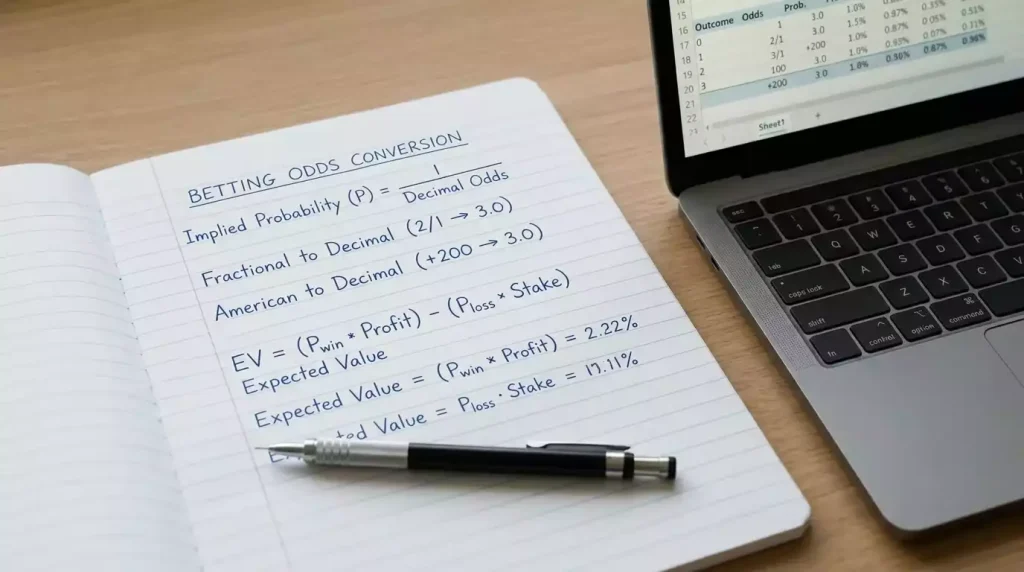
Contents
Every Odds Price Has a Hidden Win Percentage
The moment I learned to convert odds into implied probabilities was the moment my UFC betting went from a hobby to something resembling a system. Before that, I looked at a price like 4/7 and thought “that fighter is favoured.” After, I looked at 4/7 and thought “the market thinks this fighter wins 63.6% of the time — do I agree?” That shift in thinking changed everything.
Every set of odds carries an embedded win percentage. The bookmaker does not just pull numbers from thin air; the price reflects a probability estimate plus a margin. Your job as a bettor is to extract that probability, compare it to your own assessment, and bet only when the gap is wide enough to matter. Favourites won 72% of UFC bouts in 2026, but they were not all priced at 72% implied — some were priced too short, others too long, and the bettors who could tell the difference are the ones who ended the year in profit.
This guide gives you the formulas for every odds format used by UK bookmakers, walks through worked examples in pounds, and shows you how to use the results to find genuine value rather than just confirming what the market already thinks.
Implied Probability Formulas for Each Odds Format
There are three odds formats you will encounter when betting UFC in the UK: fractional, decimal, and American. Most UK-licensed sites default to fractional, but decimal is increasingly popular and American odds appear constantly on US-based analysis sites. You need to convert all three.
For fractional odds, the formula is: Implied Probability = Denominator / (Numerator + Denominator) x 100. Take 3/1 as an example. The denominator is 1, the numerator is 3. So: 1 / (3 + 1) x 100 = 25%. The market implies this fighter wins one in every four fights. For a shorter price like 2/5: 5 / (2 + 5) x 100 = 71.4%.
For decimal odds: Implied Probability = (1 / Decimal Odds) x 100. Decimal 4.00 gives you: 1 / 4.00 x 100 = 25%. Decimal 1.40 gives you: 1 / 1.40 x 100 = 71.4%. Decimal is the easiest format for quick mental calculations, which is why I use it as my default display setting.
For American odds, you need two versions of the formula. For positive American odds (underdogs): Implied Probability = 100 / (American Odds + 100) x 100. So +300 gives: 100 / (300 + 100) x 100 = 25%. For negative American odds (favourites): Implied Probability = Absolute Value of American Odds / (Absolute Value + 100) x 100. So -250 gives: 250 / (250 + 100) x 100 = 71.4%.
Notice that all three examples produce the same 25% and 71.4% results — because 3/1, 4.00, and +300 are the same price expressed in different formats. Mastering these conversions means you can read any UFC analysis source, regardless of which country it comes from, and immediately understand what probability the market assigns.
The Bookmaker’s Overround and Why It Matters
Here is something that surprised me when I first ran the numbers: if you add up the implied probabilities of both fighters in a UFC bout, the total is always more than 100%. That excess is the overround — the bookmaker’s built-in margin.
Suppose Fighter A is priced at 1/2 (66.7% implied) and Fighter B is priced at 6/4 (40.0% implied). The total is 106.7%, meaning the overround is 6.7%. In a perfectly fair market, the two fighters’ probabilities would sum to exactly 100%. The 6.7% excess is the bookmaker’s theoretical profit margin — it ensures they make money regardless of which fighter wins, assuming balanced action on both sides.
UK remote betting generated gross gaming yields of £2.6 billion in the financial year to March 2026, and the overround is one of the mechanisms that makes that revenue possible. For bettors, the overround means that the implied probabilities you extract from the odds are slightly inflated. A fighter priced at 66.7% implied probably has a “true” market probability closer to 62-64% once the overround is stripped out.
Stripping the overround is straightforward: divide each fighter’s implied probability by the total of both probabilities. In the example above, Fighter A’s “true” probability is 66.7 / 106.7 = 62.5%, and Fighter B’s is 40.0 / 106.7 = 37.5%. Those adjusted numbers sum to 100% and give you a cleaner picture of where the market really sits. I do this calculation for every fight I analyse seriously, and I recommend you build the habit too — it only takes thirty seconds and it removes the distortion that the raw odds introduce.
Using Implied Probability to Find Value in UFC Markets
Converting odds to probabilities is a mechanical skill. Finding value is a judgement skill, and it is where experience separates casual bettors from profitable ones. The process is simple to describe and difficult to execute: estimate your own probability for a fighter winning, compare it to the bookmaker’s implied probability, and bet when the difference is large enough.
How large is large enough? I use a minimum threshold of 5 percentage points. If the bookmaker implies a fighter wins 60% of the time and my analysis says 65%, I am interested but cautious. If my number is 70%, I am placing a bet. That 10-point gap gives me enough cushion to absorb the inherent uncertainty of MMA, where small sample sizes and single-punch variance make every estimate imperfect.
In 2026, underdogs priced at roughly +200 (implied 33%) or longer won 39% of their bouts — a significant departure from the historical average of 28%. That gap between the market’s estimate and reality was the single biggest source of value for the entire year. Bettors who systematically compared their own fighter assessments to implied probabilities and leaned into underdog spots when the data supported it had an outstanding year.
The discipline required is real. You will identify value bets that lose. A 60% probability still means the fighter loses four times out of ten. The edge only shows up over a meaningful sample — dozens or hundreds of bets, not five or ten. If you bet UFC once a month, you will never accumulate enough volume for the edge to materialise. If you bet every card with consistent method, the maths works in your favour over time.
One practical tip I wish someone had told me earlier: keep a record of your pre-fight probability estimates alongside the bookmaker’s implied probability and the actual result. After fifty bets, review the data. If your estimates consistently outperform the bookmaker’s, your odds-reading process is working. If they do not, adjust your method before risking more capital.
