
UFC Line Movement Explained: Why Odds Shift and What It Tells You
 Available in US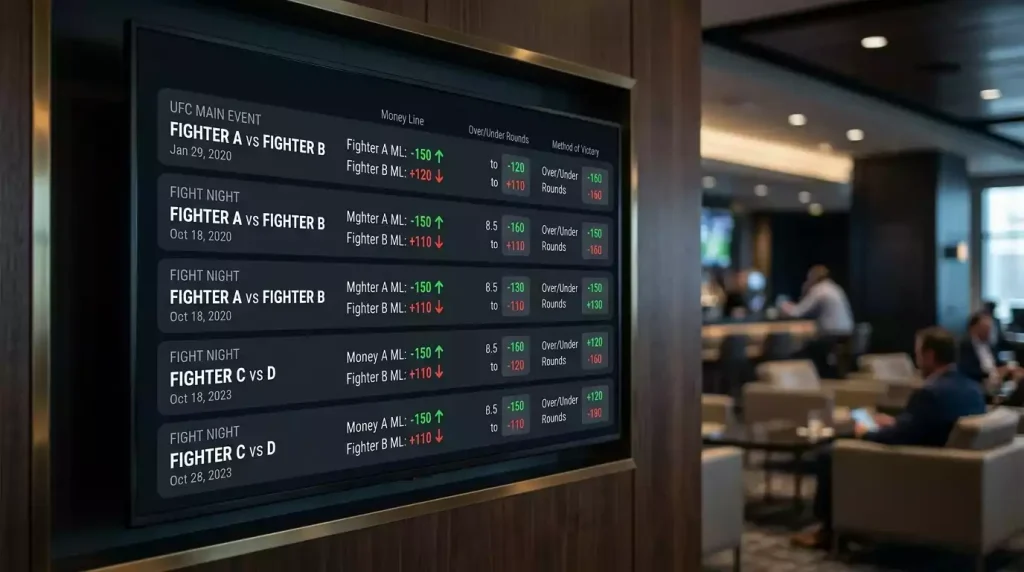
Contents
Odds Are Not Static — And the Shifts Hold Clues
The first time I noticed a UFC fighter’s odds move from -250 to -130 in the space of a few hours, I assumed it was a glitch. It was not. That fight — Isaac Dulgarian vs Yadier del Valle in November 2026 — turned out to be flagged for suspicious betting activity, and the line movement was the market screaming that something was wrong before anyone publicly acknowledged it.
Most bettors check the odds once, place their bet, and forget about it. That approach leaves money on the table because the line between when odds open and when the fight starts is a living record of information flowing into the market. Sharp bettors, injury news, camp rumours, weigh-in results, and sometimes far less legitimate factors all leave fingerprints on the odds. Learning to read those fingerprints has become one of the most valuable skills in my betting process.
What Makes UFC Lines Move: Injuries, Money, and Information
UFC odds typically open seven to ten days before a fight, though major pay-per-view main events may get lines as early as two weeks out. From the moment the opening line appears, three forces push it around.
Injury and training-camp news is the most straightforward cause. A fighter posts a training video showing limited mobility in their lead hand, and within hours the line moves. A credible reporter tweets that a fighter missed sparring sessions due to a knee issue, and the market adjusts. These moves are usually gradual — a few ticks over several hours as the information spreads from insiders to the broader betting public.
Money — specifically, who is betting and how much — is the second driver. When a well-funded sharp bettor places a large wager on one side, the bookmaker adjusts the line to reduce their exposure. These “steam moves” happen quickly and are often the first sign that sophisticated analysts have a strong opinion on the fight. Dana White acknowledged the information pipeline when discussing the integrity monitoring firm IC360, noting that they “reached out and told us there was some unusual action going on” before a flagged bout.
Public sentiment is the third force, and it moves lines more slowly. As fight week builds and the casual betting public starts placing wagers, the line can drift towards the more popular fighter. This is especially visible with high-profile fighters who attract fan money regardless of their actual chances. A fighter who is famous for knockouts will draw public money even when the matchup analysis suggests they are overvalued.
Sharp Money vs Public Money in MMA Markets
Distinguishing between sharp and public money is easier in theory than in practice, but after tracking line movements across hundreds of UFC cards, I have developed a few reliable heuristics. The total MMA betting handle reached $10.3 billion in 2026, a 17% increase year on year, which means the pool of both sharp and recreational money flowing into these markets is growing rapidly.
Sharp money tends to arrive early in the week, often within the first 24 hours of a line opening. These bettors have done their analysis, identified their edge, and want to get the best price before the market adjusts. If you see a significant move on Monday or Tuesday for a Saturday fight, it is more likely sharp money than public action.
Public money arrives late — Thursday evening through Saturday afternoon, peaking in the hours before the first fight. Public bettors are influenced by pre-fight media coverage, embedded episodes, press conferences, and weigh-in optics. If a fighter looks shredded at the weigh-in and the line moves in their favour on Friday afternoon, that is public money reacting to visuals rather than analysis.
The practical takeaway: when sharp and public money agree (both pushing the line the same direction), the move is strong and I rarely bet against it. When they disagree — sharp money moved the line early in one direction, and public money pushes it back later — I pay very close attention. That reverse movement sometimes creates value on the sharp side, because the public action has pushed the price back towards where it started, giving you a second chance at the number the sharps liked.
How to Read and React to Line Movement
Reading line movement is a supplementary tool, not a primary strategy. I never bet a fight solely because the line moved — movement is a signal that someone else has information or a strong opinion, but without knowing what that information is, you are guessing. My approach is to use line movement as confirmation or contradiction of my own analysis.
If I have analysed a fight and concluded that Fighter B is undervalued at 2/1, and then I see the line move from 2/1 to 7/4 early in the week (indicating sharp money on Fighter B), that confirms my view and gives me confidence to increase my stake slightly. If the line moves the opposite way — from 2/1 to 5/2, with sharp money apparently on Fighter A — I go back and re-examine my analysis. I do not automatically abandon my position, but I want to understand what the market might be seeing that I missed.
Timing matters. I generally place my bets on Tuesday or Wednesday for a Saturday card, after the opening sharp moves have settled but before the public money distorts the line. This gives me a price that reflects informed analysis without being skewed by late recreational action. If the line moves significantly after I have already bet, I do not chase it. The price I got is the price I got.
One habit worth developing: track the closing line (the final odds at fight time) against the opening line for every fight on a card, even the ones you did not bet. Over time, you will start to see patterns in which types of fights produce the biggest movements and which tend to stay stable. That pattern recognition feeds directly into your broader strategy.
When Movement Signals Something Worse Than Bad News
Most line movement is legitimate — money reacting to information, form, or matchup analysis. But occasionally, the movement signals something far more troubling. The Dulgarian-del Valle fight I mentioned earlier saw its line shift from -250 to -130 in a matter of hours, a magnitude of movement that no injury report or training-camp rumour would explain. The bout was subsequently flagged for suspicious betting activity.
In January 2026, the UFC pulled a fight from the UFC 324 card entirely due to suspicious wagering patterns — the first time the promotion had taken such a preventive measure. These incidents are rare, but they are real, and as a bettor you should know what the warning signs look like. A dramatic, unexplained line movement late in fight week — particularly one that moves a heavy favourite towards pick-em territory without any public news — is a red flag.
What should you do when you spot potential suspicious movement? The simplest answer: stay away. Do not bet on a fight where the market is behaving irrationally, regardless of which direction you think the irregularity points. Integrity monitoring exists to protect the market, but it operates on a detection-and-response timeline that can be slower than the betting window. If something looks wrong, trust your instinct and pass on the fight. There are 43-plus UFC events per year — you will never run out of opportunities to bet on clean fights.
