
UFC 10-Point Must System: How Judges Score Fights and Why It Matters for Bettors
 Available in US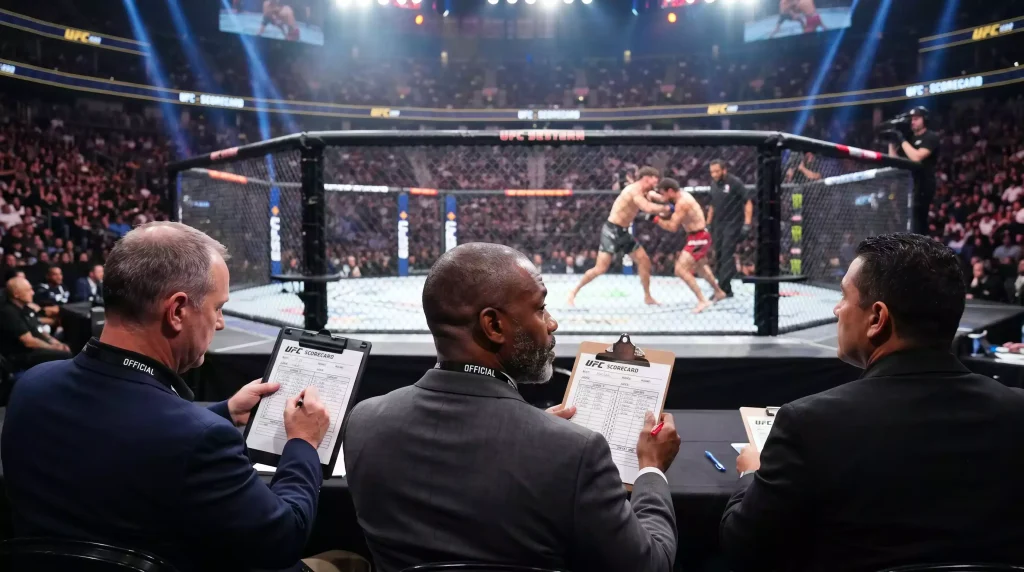
Contents
Judging Decides More UFC Fights Than Knockouts Do
The first time I lost money on a fight that went to decision, I was furious — not at the judges, but at myself. I had spent hours analysing striking metrics and grappling exchanges without once considering how the scoring system actually works. It was like studying for a maths exam without knowing whether the questions would be multiple choice or essay format. Out of 428 bouts between January and October 2026, 238 ended by judges’ decision — that is 56% of all fights resolved by scorecards rather than finishes. If you are betting on UFC without understanding how those scorecards are filled in, you are ignoring the mechanism that determines more than half of all outcomes.
The 10-point must system is borrowed from boxing, adapted for MMA, and frequently misunderstood by fans and bettors alike. This is your guide to how it works, what judges are actually looking for, and how that knowledge can sharpen every decision bet, point spread wager, and over/under you place.
How the 10-Point Must System Works in Practice
I explain it to new bettors like this: imagine each round is a fresh exam, and one fighter must receive a 10 while the other receives 9 or less. The “must” in 10-point must means the winner of each round always gets 10 points — no exceptions. The loser gets 9 in a competitive round, 8 in a round featuring a significant dominance gap, or 7 in the rare instance of total one-sided destruction.
Three judges sit cageside, each scoring independently. They evaluate four criteria established under the Unified Rules of Mixed Martial Arts: effective striking, effective grappling, Octagon control, and effective aggressiveness. These criteria are not weighted equally. Effective striking and grappling are considered the primary factors — the ones that most directly determine who is winning the fight. Octagon control and aggressiveness serve as tiebreakers when the striking and grappling are closely matched.
Effective striking is not simply about throwing more punches. Judges are instructed to assess the impact and damage caused by strikes, prioritising clean, significant blows over volume. A fighter who lands thirty jabs to the guard matters less than one who lands five flush hooks that visibly wobble their opponent. This distinction is critical for bettors evaluating round-by-round performance, because the fighter who appears busier on the broadcast may not be the one winning on the scorecards.
Effective grappling follows a similar logic: securing takedowns, advancing position, and threatening submissions carry more weight than simply holding an opponent against the fence without creating offence. A fighter who takes their opponent down but spends three minutes in guard without advancing or striking is generating control time but not necessarily winning the round on the grappling criterion.
When Judges Award a 10-8 Round — and Why Bettors Should Care
I once watched a fight where one fighter dropped the other twice, nearly finished the bout, and dominated every exchange for an entire round. The scorecards read 10-9. The crowd booed. Social media erupted. And anyone who had bet on the dominant fighter to win by decision suddenly realised that a round they assumed was a blowout had been scored only marginally in their favour.
The 10-8 round is the most consequential and least consistently applied scoring tool in MMA. Under the revised Unified Rules, a 10-8 should be awarded when one fighter dominates a round through impact, duration of dominance, or visible damage. In theory, a round where Fighter A knocks down Fighter B and controls the remaining four minutes with heavy ground strikes should be a clear 10-8. In practice, judges remain inconsistent about when to use it.
The overall finish rate across UFC is roughly 53%, which means the remaining 47% of fights go to scorecards where 10-8 rounds can swing the result dramatically. A single 10-8 in a three-round fight changes the mathematics entirely. Without it, a fighter needs to win two of three rounds to take the decision. With a 10-8 in their favour, they could lose the other two rounds 10-9 and still draw 28-28 rather than losing 29-28. In a five-round championship bout, a 10-8 round creates even more complex scoring scenarios that most casual bettors never model.
For bettors, the practical takeaway is this: when you are evaluating whether a fight is likely to produce a close decision or a comfortable one, consider whether either fighter has the style to generate 10-8 rounds. Fighters with devastating ground-and-pound, high knockdown rates, or aggressive submission chains are more likely to produce dominant rounds that shift scorecards in their favour — and that shift affects everything from decision betting to method-of-victory markets.
How Scoring Knowledge Improves Your Betting
Early in my betting career, I treated decision markets as coin flips — pick the fighter I thought would win and hope the judges agreed. It took dozens of losing bets before I started approaching these markets with the specificity they demand. Understanding the scoring system does not just help you pick winners; it helps you identify which fights are likely to produce controversial splits, which fighters consistently win close rounds, and which matchups carry hidden decision risk.
Start with this framework: if both fighters are durable, technically skilled, and unlikely to finish each other, the fight will probably go to scorecards. Once you have established that baseline, ask which fighter’s style aligns better with the judging criteria. A volume striker who pushes forward and controls the centre of the Octagon ticks three of the four scoring boxes — effective striking, Octagon control, and aggressiveness — even if their opponent lands the cleaner individual shots. Judges reward activity more consistently than they reward precision, and that tendency creates exploitable patterns in decision markets.
Watch for fighters who are strong in rounds one and two but fade in the third. In a three-round bout, winning the first two rounds decisively and losing a close third still produces a clear 29-28 or even 30-27 if the winning rounds were dominant. Conversely, a fighter who starts slowly but finishes strong needs to be genuinely dominant in those later rounds to overcome early deficits on the cards. The scoring system does not weight later rounds more heavily than earlier ones — another boxing assumption that does not transfer to MMA.
The fighters who consistently generate split decisions — the ones where two judges see it one way and the third disagrees — represent both risk and opportunity. If you can identify these fighters before the market does, you can find value in the decision props and avoid overpaying for certainty that does not exist.
