
UFC Point Spread Betting: How Handicap Markets Work in MMA
 Available in US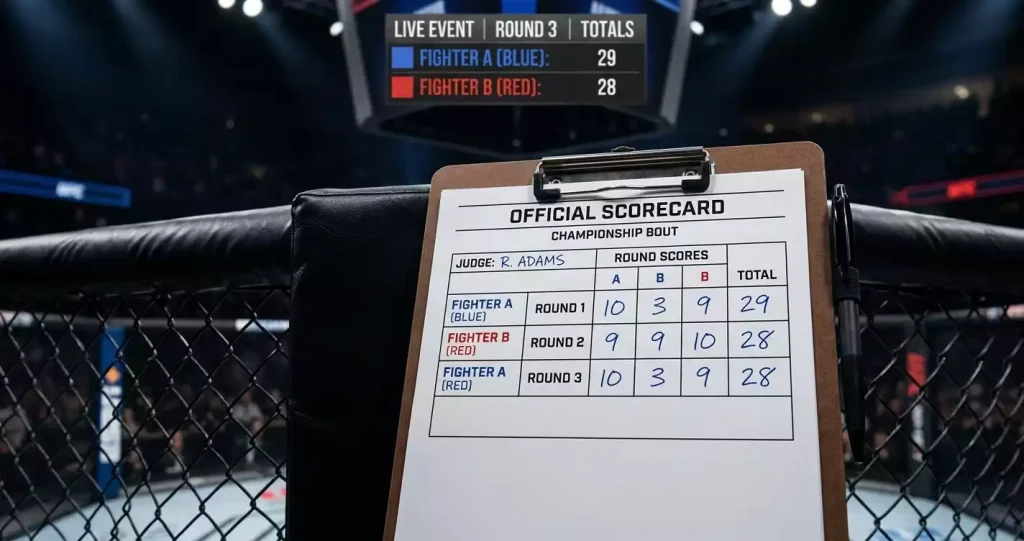
Contents
Point Spreads Exist in UFC — Most Bettors Just Have Not Seen Them
I spent my first two years betting on UFC without realising that point spread markets existed. The moneyline dominated my thinking, and I assumed MMA was too binary — win or lose — for handicap betting to make sense. Then I stumbled across a spread line on a championship fight, dug into the mechanics, and realised I had been ignoring an entire market that solved one of my biggest frustrations: how to bet on a heavy favourite without accepting thin moneyline returns.
Point spread betting in UFC works differently from the spreads you see in football or basketball. There is no running score during a fight. Instead, UFC spreads are based on the 10-point must scoring system used by judges, and they only pay out if the fight goes to a decision. That structural difference makes UFC point spreads a niche market — available less frequently, understood by fewer bettors, and occasionally mispriced because of it.
How UFC Point Spreads Use the 10-Point Must System
In the 10-point must system, judges score each round by awarding 10 points to the winner of the round and 9 or fewer to the loser. A typical round where one fighter clearly outperforms the other is scored 10-9. A dominant round with knockdowns or near-finishes can be scored 10-8. In rare cases of complete domination, a 10-7 is possible, though it almost never happens.
A UFC point spread is set as a handicap on one fighter’s scorecard total relative to the other’s. A spread of -2.5 on Fighter A means Fighter A must win the fight on the judges’ scorecards by more than 2.5 points for the spread bet to pay out. In a three-round fight scored 29-28, the margin is 1 point — not enough to cover a -2.5 spread. A score of 30-27 gives a margin of 3, which covers the spread.
The 428 bouts held between January and October 2026 produced 238 decisions — roughly 56% of all fights. That means point spread bets have a reasonable sample of applicable outcomes, but they also carry the inherent risk that a finish voids the bet entirely. Most bookmakers void spread bets if the fight does not go to the scorecards, returning your stake. This is a critical detail: you are essentially betting on the margin of a decision, and your bet only lives if a decision actually occurs.
The half-point in the spread (the .5) eliminates the possibility of a push. A spread of -2.5 can only win or lose, never tie. Some bookmakers offer whole-number spreads (-3, -4) with push rules, but half-point spreads are far more common in UFC and simplify the settlement.
Which Fights Get Point Spread Markets
Not every UFC fight attracts a spread market. Bookmakers typically offer point spreads only on main event and co-main event fights — bouts that generate enough betting volume to justify the additional market, and that feature fighters with established enough records for meaningful handicap pricing. The overall finish rate in UFC sits around 53%, which means nearly half of all fights do not produce a decision. For a point spread to make sense, the bookmaker needs the fight to have a realistic probability of going the distance.
Five-round championship fights and main events are the most common home for spread markets. The extra two rounds increase the probability of a decision (more time for a close fight to reach the scorecards) and widen the potential point margin, making larger spreads viable. In a three-round fight, the maximum realistic margin is about 6 points (30-24, which would require three 10-8 rounds). In a five-round fight, the maximum realistic margin extends to 10 points, creating a wider range for spread pricing.
Fights between two durable, defence-first fighters are the most likely to produce spread markets with tight lines. If both fighters have decision rates above 50%, the bookmaker can price the spread with reasonable confidence that the bet will actually settle on a scorecard rather than voiding on a finish. Fights between two aggressive finishers rarely attract spread markets because the probability of a decision is too low to build a reliable line around.
Spread vs Moneyline: When the Handicap Offers Better Value
The classic use case for a UFC point spread is a fight where you are confident the favourite will win but the moneyline price is too short to justify the risk. A fighter priced at 1/5 on the moneyline returns just £2 profit on a £10 stake. The same fighter at -2.5 on the spread might be priced at 4/5 or even evens, because covering the spread requires not just a win but a convincing win on the scorecards.
I use spreads when three conditions align: I expect the favourite to win, I expect the fight to go to a decision, and I expect the favourite to control multiple rounds clearly enough to cover the handicap. If any one of those conditions is uncertain, the moneyline is safer despite the thinner return. The spread amplifies both the reward and the risk, and it only makes sense when your analysis supports the specific scenario it requires.
There is also a contrarian angle. Backing the underdog on a +2.5 spread means the underdog can lose the fight on the scorecards by up to 2 points and your bet still wins. In a close fight scored 29-28, the underdog loses the bout but covers the +2.5 spread. This is a useful structure for fights where you think the underdog is competitive but unlikely to win outright — a common scenario in championship bouts where the challenger pushes the champion but falls just short. The underdog spread is the bet type that lets you monetise “competitive loser” without needing an outright upset.
