
UFC Over/Under Rounds Betting: How Total Rounds Markets Work
 Available in US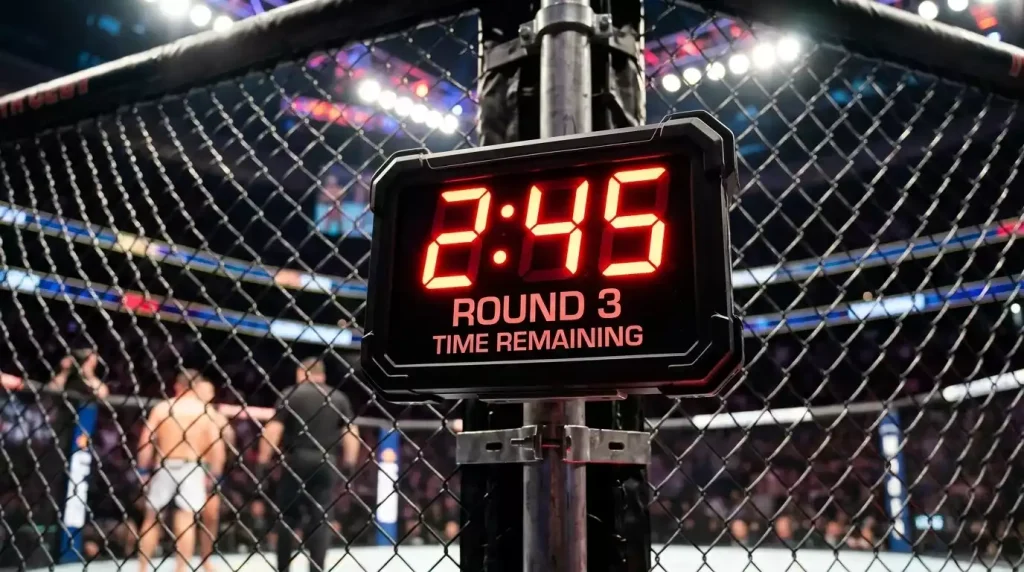
Contents
Betting on Fight Duration Without Picking a Winner
Some of my best UFC betting months have come from fights where I had absolutely no idea who would win. That sounds counterintuitive until you understand over/under rounds — a market that removes the winner question entirely and asks you something different: how long will this fight last?
With roughly 53% of UFC bouts ending before the final bell, the fight-duration market is far from a coin flip. Every fight card contains at least a handful of bouts where the stylistic matchup makes the duration more predictable than the winner. Two knockout artists with fragile chins? You do not need to know which one lands first to know the fight probably ends early. Two elite wrestlers with cardio for days? That bout is going the distance regardless of who takes the decision.
Over/under rounds is my go-to market when I have a strong opinion on fight dynamics but a weak opinion on the outcome. It also tends to be priced less efficiently than the moneyline, because casual bettors overwhelmingly gravitate towards picking winners and leave the round-total market to those of us who actually dig into the data.
How Over/Under Lines Are Set: 1.5, 2.5, and Title Fight Thresholds
The first thing that confuses new bettors about this market is the half-round increment. A line of “over/under 2.5 rounds” does not mean halfway through round three in real time. In UFC scoring, a round is only completed when it finishes. The 2.5 threshold means: if the fight ends at any point during rounds one or two, the under hits. If the fight reaches any point in round three (even one second into it), the over hits.
For standard three-round bouts, the most common line is 2.5 rounds. Occasionally, bookmakers will also offer 1.5 rounds when a fight features two heavy hitters or a massive skill gap. The 1.5 line asks a simpler question: does this fight survive the first round? If it ends in round one, the under cashes. If it reaches round two, the over cashes.
Championship and main-event bouts scheduled for five rounds introduce additional thresholds. You will see lines at 1.5, 2.5, 3.5, and 4.5 rounds. The 4.5 line is essentially asking whether the fight goes to a decision — if it ends at any point in rounds one through four, the under hits; if it reaches round five, the over hits. I find the 3.5 line in five-round fights particularly interesting because it sits at the inflection point where cardio starts to separate fighters. A bout between two well-conditioned athletes often sails past 3.5, while a fight involving a fighter with known cardio issues frequently does not.
Bookmakers set these lines based on a combination of divisional base rates, fighter-specific finish data, and betting patterns. The opening line reflects their model; the closing line reflects where the money has pushed it. Understanding that distinction is useful because sharp bettors tend to move round-total lines early in fight week, while public money arrives closer to the event and can push the line away from the “correct” number.
Which Divisions Run Long and Which End Early
I spent a full weekend once charting round-total results by weight class, and the patterns were so clear I could not believe I had not done it sooner. The data aligns with what physics would predict: heavier fighters hit harder, and harder hits end fights faster.
Heavyweight is the extreme. Nearly half of all heavyweight bouts end by KO or TKO, and roughly 70% of heavyweight finishes come from strikes rather than submissions. The under 2.5 hits at a rate that makes it a staple of my heavyweight betting. When two heavyweights with knockout power meet, I default to the under unless one or both fighters have demonstrated an ability to survive exchanges consistently.
At the other end of the scale, women’s bantamweight has produced a 96% rate of fights going past 1.5 rounds since 2020. That statistic — 27 out of 28 bouts clearing the threshold — is one of the most reliable edges in UFC betting. If you see an over 1.5 line in women’s bantamweight priced anywhere near -150 or shorter, the data says take it and move on.
Lightweight and featherweight sit in the middle, leaning towards the over. Fighters in these classes combine speed and durability in a way that produces longer, more technical fights. Bantamweight and flyweight push the trend further towards decisions. The practical takeaway: always check the divisional base rate before betting a round total, because a line that looks generous at heavyweight may be terrible value at flyweight.
Strategies for Over/Under Bets: Pace, Age, and Cardio
Divisional base rates give you a starting point, but the real edge comes from matchup-specific adjustments. Over nine years of betting round totals, three factors have proven most reliable for nudging my estimate away from the baseline.
Pace is the first. Fighters who push a high output from the opening bell create more opportunities for finishes. When two high-pace fighters meet, the under becomes more likely than the divisional average would suggest. Conversely, two counter-strikers who wait for openings will often produce a slow fight that drifts to the scorecards. I track average strikes landed per minute as a proxy for pace, and the gap between two high-volume fighters and two low-volume fighters can shift my round-total probability by 15-20 percentage points.
Age matters because older fighters tend to slow down in later rounds, but they also tend to start cautiously. A 37-year-old veteran facing a 25-year-old prospect often fights conservatively early, banking on experience to win the later exchanges. That dynamic pushes the fight longer, favouring the over. The exception is when the older fighter has obvious physical decline — then the younger opponent may force an early finish, and the under becomes attractive.
Cardio is the third factor, and it is the hardest to quantify. A fighter who has never been past the third round is a genuine unknown in a five-round championship bout. If both fighters in a five-round fight have questionable cardio, the 3.5-round over can be a trap — the fight may drag through early rounds at low pace and then one fighter collapses in the fourth. I look for weight-class-specific patterns in cardio because a lightweight with good cardio and a heavyweight with good cardio are operating at completely different absolute levels of conditioning.
One final note on strategy: avoid the temptation to parlay round totals with moneylines unless the two bets are genuinely correlated. Backing Fighter A on the moneyline and the under only makes sense if Fighter A’s most likely path to victory involves an early finish. If Fighter A is a decision machine, you are creating a parlay where one leg works against the other.
